Behr Dream Tiny.
It started with a contradiction. How do you sell paint to people who’ve decided they need less?

/
Challenge
(01)
The tiny house movement wasn’t just about square footage. It was a cultural statement, a quiet rebellion against excess, a recalibration of what enough means.
People were shedding possessions, downsizing dreams to three hundred square feet, and somehow finding more freedom in less space. And here was Behr, a paint company synonymous with suburban renovation projects and big box stores, wondering how to be part of that conversation without cheapening it. The question wasn’t how to market to tiny house enthusiasts. It was how to honor what they were actually doing and find our place within it.
I began where all good stories begin: by listening. Not to focus groups or market research decks, but to the people themselves. I spent weeks immersed in online communities, forums, Instagram accounts documenting builds, YouTube channels showing the unglamorous reality of composting toilets and loft beds. I read personal essays about why a teacher in Oregon sold her four-bedroom house to live in a custom-built structure smaller than most people’s garages. I watched a couple in Tennessee paint their tiny house a soft sage green, their hands covered in primer, laughing about how they’d argued over the colour for three days because in a space that small, every choice matters exponentially.
What I found wasn’t a demographic. It was a philosophy. These weren’t people trying to save money, though some were. They weren’t minimalists performing austerity for social media clout, though some were that too. Most were people asking a fundamental question about how to live deliberately. About what we surround ourselves with and why. About the difference between a house and a home. The tiny house wasn’t the point. It was the canvas for something bigger: intentionality, self-determination, creative problem-solving. And colour, I realized, played a surprisingly emotional role in that process.
One woman in Colorado described spending an entire weekend choosing paint for her twelve-foot living area. “In a normal house, if you hate the bedroom colour, you close the door,” she wrote. “Here, there are no doors. The colour is always with you. It has to feel right.” Another builder in North Carolina talked about how he’d painted his tiny home’s exterior a deep charcoal blue because “it needed to feel like it belonged to the woods, not imposed on them.” Colour wasn’t decoration. It was identity. It was the emotional temperature of the space. It was one of the few ways to personalize a structure that by necessity eliminated most personal belongings.
The insight clarified: people weren’t building tiny houses despite limitation. They were building them because of it. Constraint was the design principle. Every choice was a negotiation between function and meaning. And Behr, whether we knew it or not, was already part of those negotiations. I found our paint in dozens of tiny house builds, usually bought without much thought because it was accessible and affordable. We were present, but invisible. The opportunity wasn’t to sell more paint. It was to become part of the story people were telling about why they built, what they valued, how they wanted to live
/
Solution
(02)
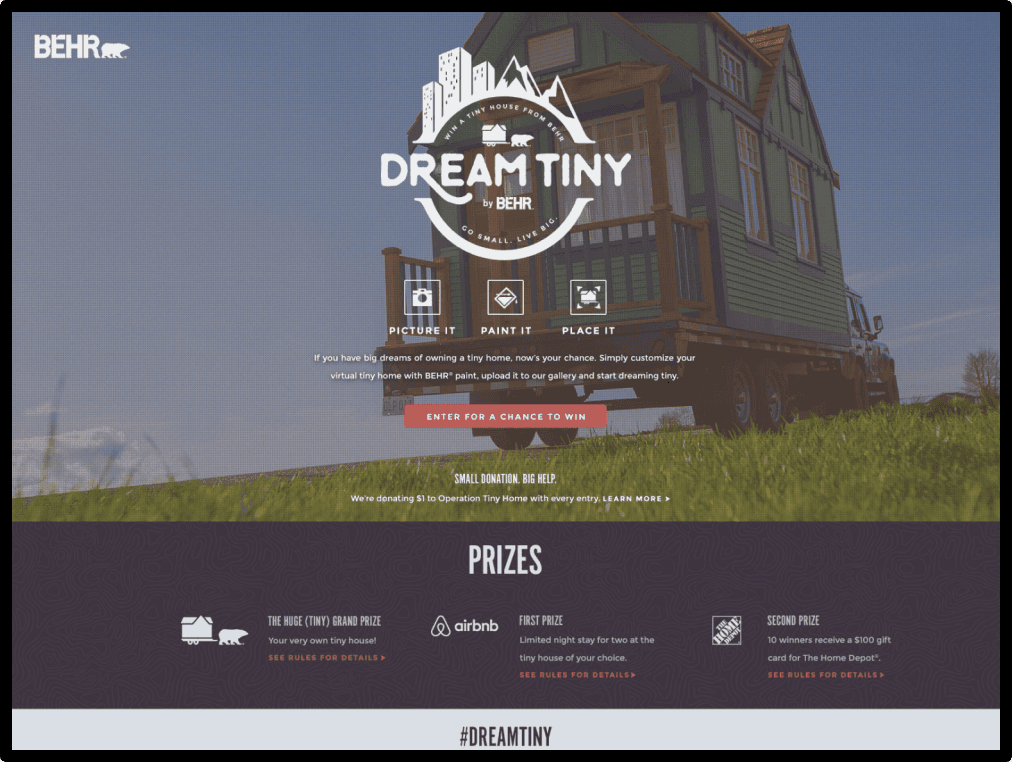
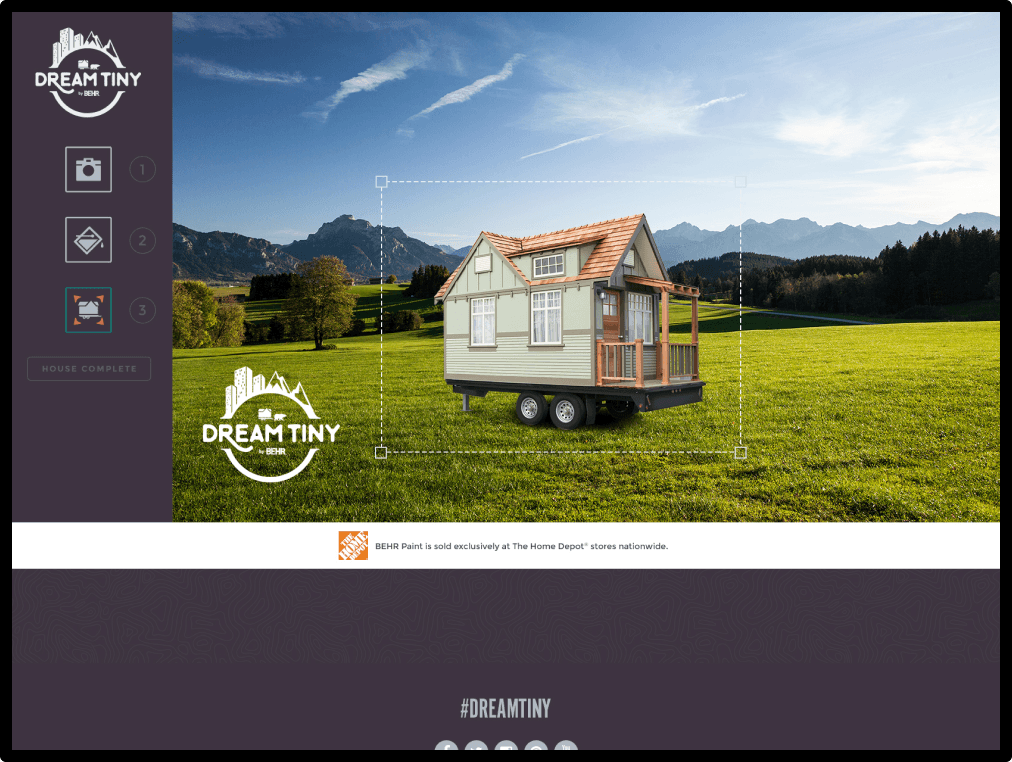
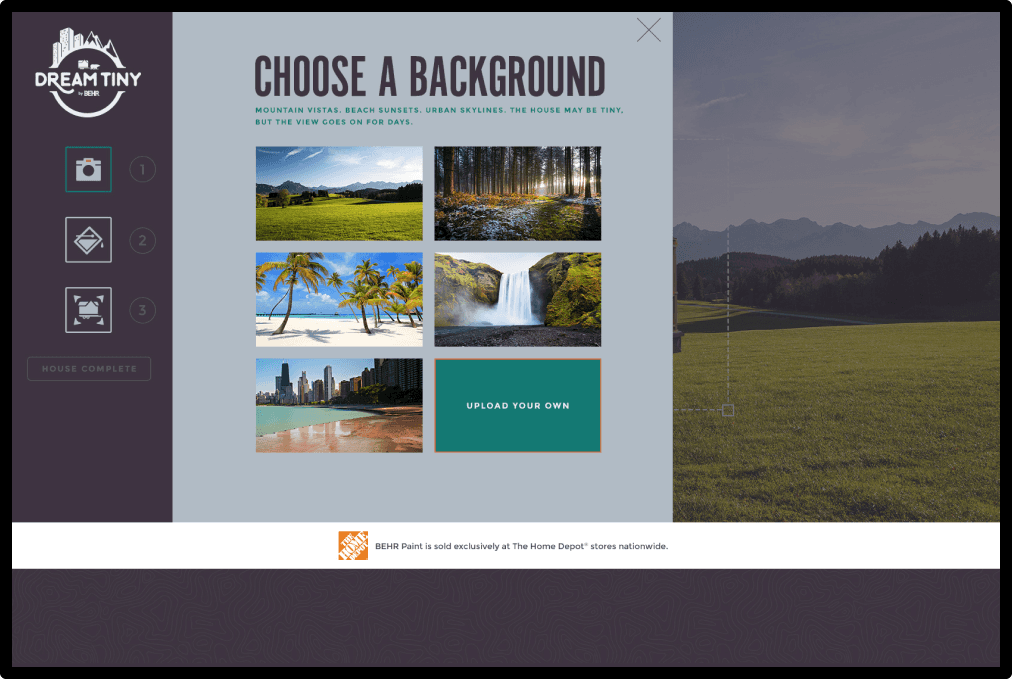
A transmedia narrative campaign that positioned Behr not as a product, but as a collaborator in the creative act of building a life with less.
We wouldn’t show perfect tiny houses with perfect paint jobs. We’d document the journey of real builders making real decisions, and we’d explore what colour meant within that context. The campaign needed to work across platforms because that’s where these communities lived. Instagram for inspiration, YouTube for process, blogs for reflection, email for intimacy. Each platform would offer a different entry point into the same central narrative: that small spaces demand big intention, and colour is one of the most powerful tools we have to shape how a space feels.
I started by identifying six builders at different stages of their journey. A single mother in Washington building in her parents’ backyard. A retired couple in Arizona designing their dream retirement on wheels. A young carpenter in Vermont constructing his first tiny home as both residence and portfolio piece. Each had a story. Each had a reason. I spent hours on video calls with them, asking not about paint preferences but about fear, hope, compromise, vision. What were they leaving behind? What were they building toward? The carpenter told me he was afraid of finishing, of the moment the project ended and he’d have to confront whether the life he’d imagined actually worked. The retired couple laughed about arguing over whether to paint the interior white for spaciousness or blue for calm. They chose blue. “We spent forty years in beige tract housing,” the husband said. “We’re done playing it safe.”
The content framework emerged from those conversations. We’d follow their builds over six months, but not as a product demonstration. As a narrative arc with emotional stakes. The beginning: decision and doubt. The middle: problem-solving and setback. The end: inhabitation and reflection. Colour would be woven throughout, not as the focus, but as a recurring motif. The moment they chose their palette. The day they painted their first wall. The evening light hitting that colour three months after move-in. We’d show the decision-making process, the mistakes, the repaints, the tiny victories. I worked with a small production team to capture everything in a documentary style, handheld, natural light, no voiceover, just the builders’ own words.
Instagram became our visual journal. Behind-the-scenes photographs of builders mid-process, paint swatches taped to unfinished walls, before-and-after transformations, quiet moments of exhaustion and triumph. We posted three times weekly, always with story, never just product. The carpenter crouched in his loft, painting trim at midnight. The mother and her daughter choosing a cheerful yellow for the reading nook. The retired couple standing back to admire their blue kitchen, still in their paint-splattered clothes. Captions were written in their voices, first person, honest about the hard parts. “Repainted this corner twice. Turns out ‘seafoam’ and ‘mint’ are very different when you’re living with them.”
YouTube gave us space for longer storytelling. Ten-minute episodes released monthly, each focusing on a specific challenge or milestone. The carpenter explaining how he designed his colour palette around the view from his window, choosing greys and greens that would recede when the forest was in focus. The mother talking about how her daughter, seven years old, had insisted on painting her sleeping loft “adventure purple” and how she’d learned to let go of her adult aesthetic anxieties. These weren’t commercials. They were short documentaries about people making a thousand small decisions that added up to a life.
The blog, hosted on Behr’s site but written by the builders themselves, became the reflective space. Essays about what they’d learned, advice for others considering tiny living, honest accounts of what surprised them. The retired couple wrote about their first argument in the finished house, how there was nowhere to storm off to, how they’d had to sit on their tiny porch and actually talk it through. The carpenter wrote about the unexpected intimacy of living in something he’d built with his own hands, how he noticed every seam, every flaw, every choice, and how that awareness changed his relationship to the space. These posts were shared widely in tiny house communities, often with no mention of Behr, which was exactly the point.
Email became our most intimate channel. A monthly newsletter, not about products or promotions, but about the emotional reality of living small. We invited subscribers to share their own stories. Hundreds responded. A woman in Maine sent photos of her tiny house, periwinkle blue, built after her divorce. “I needed something that was completely mine,” she wrote. “Choosing that colour felt like choosing myself.” We featured her story in the next newsletter. The community started talking to each other, not just to us.
/
Conclusion
(03)
Halfway through the campaign, something unexpected happened. The builders started collaborating with each other, sharing advice, troubleshooting problems, forming friendships.
The carpenter drove to Washington to help the single mother install her siding. The retired couple video-called with the Vermont builder to show him their storage solutions. What had started as six individual narratives became an interconnected story about community, about people helping each other build unconventional lives. We documented this too, because it was too good, too human, too real to ignore.
The campaign culminated in a live event, or rather, six simultaneous small gatherings. Each builder hosted an open house in their completed tiny home, inviting local community members, other builders, and anyone curious about tiny living. We livestreamed all six events on YouTube, cutting between locations, showing the diversity of approaches, designs, colour choices, lives. The mother’s daughter gave tours in her adventure purple loft. The retired couple served coffee in their blue kitchen, pointing out every thoughtful detail. The carpenter sat on his porch, surrounded by forest, talking about how building this structure had taught him as much about himself as about construction.
The metrics were strong. Instagram engagement rates averaged twelve percent, triple industry standard. YouTube videos accumulated over two million views. Email open rates hovered around forty-five percent. The blog posts were shared across tiny house forums and Facebook groups, generating thousands of organic backlinks. But numbers alone don’t capture what happened. The campaign had tapped into something deeper than product awareness. It had become part of the cultural conversation about intentional living, about what home means, about creativity within constraint.
When the Shorty Awards recognized the campaign for Digital Storytelling, the judges’ comments focused on authenticity and emotional resonance. “This campaign understood that digital storytelling isn’t about platforms or metrics, it’s about making people feel something real.” What they didn’t know was that by the time we won, the campaign had taken on a life beyond Behr’s control. The builders were still sharing updates, the community was still growing, and hundreds of people building their own tiny houses were tagging Behr not because we asked them to, but because we’d become part of their story in a way that felt genuine.
One moment encapsulates everything. Three months after the campaign officially ended, I received an email from a woman in Montana. She’d been following the campaign, inspired by the mother and daughter’s story. She’d just finished painting her own tiny house, a soft coral that reminded her of her grandmother’s kitchen. “I wanted to thank you,” she wrote. “Not for the paint, though it’s lovely. For showing me that choosing this life, and choosing this colour, wasn’t frivolous. It was brave.” She attached a photo. Her tiny house glowing in the late afternoon light, perched on a hillside, that coral catching the sun. It was beautiful. Not because of the paint, though the paint helped. Because someone had looked at all the choices available to them and decided this was enough. This was exactly right.
What Behr learned, what I learned, is that the best brand stories aren’t about brands at all. They’re about people and what matters to them. Our job wasn’t to insert ourselves into the tiny house movement, it was to illuminate what was already there and honour it with attention and care. Digital storytelling isn’t a format or a platform. It’s a commitment to telling true stories well, to trusting that authenticity creates connection, and to understanding that sometimes the most powerful thing a brand can do is step back and let people see themselves in what you’ve made. The award was gratifying, but it wasn’t the point. The point was the woman in Montana, and the hundreds like her, who felt seen. That’s the work. That’s what lasts.
Latest Projects.
©maxicabrera
A curated selection of projects that reflect my commitment to simplicity and purposeful design.